Room for Change
When does something stop being the same? A ship whose parts are replaced, plank by plank. A body that changes. A landscape that is transformed. A relationship that takes on a different shape along the way. You could say that everything changes. And yet, we still recognise something. We continue to call it the same ship, the same place, the same person. This is precisely where The Argonauts begins.
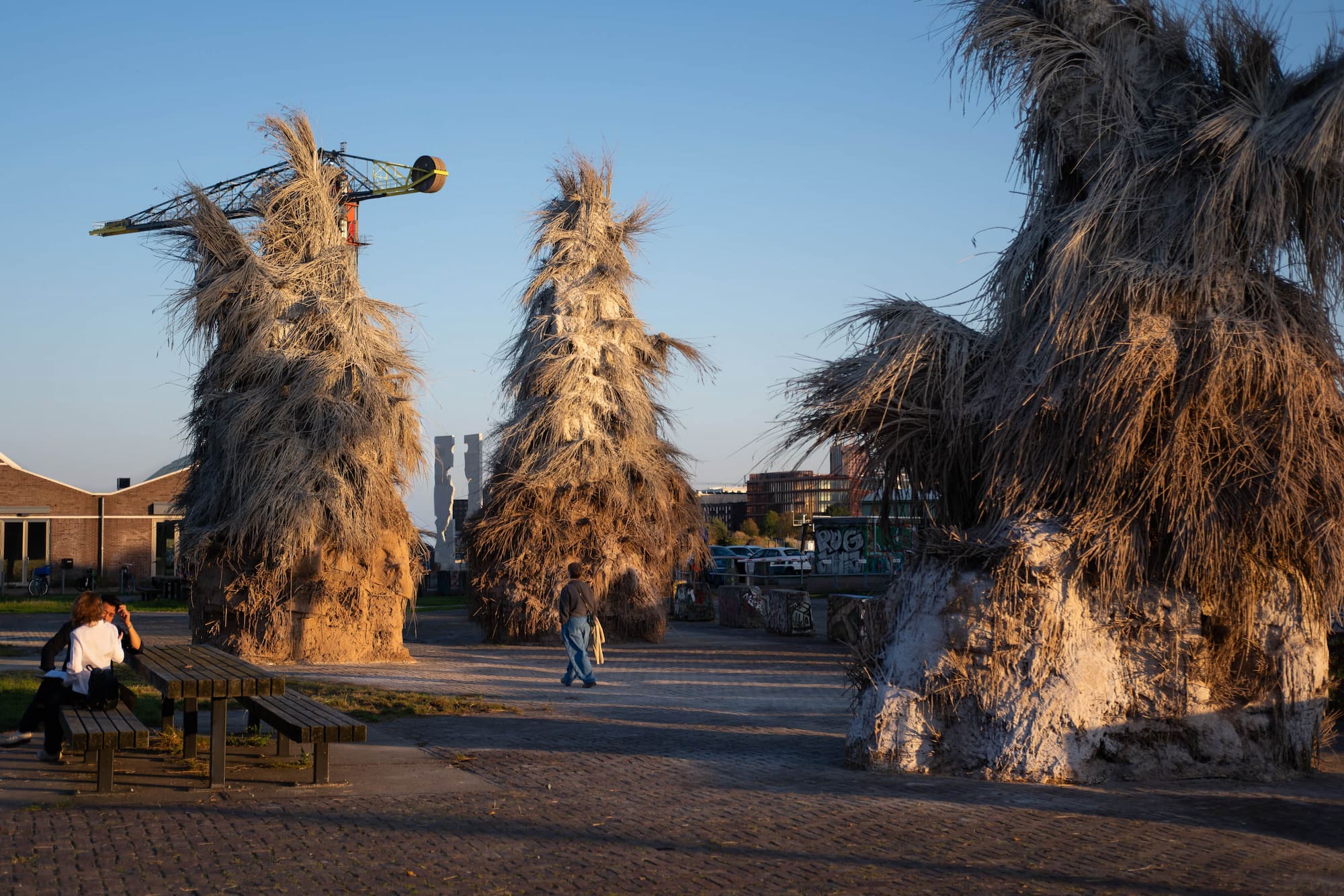
The title of Ivan Morison’s new work on the NDSM wharf refers to the sailors aboard the Argo in Greek mythology. During their voyages, parts of the ship are replaced until, eventually, none of its original components remain. And yet, it is still the Argo. An age-old paradox, but also a surprisingly timely question: how much can something change before it becomes something else?
Morison arrived at this question through Maggie Nelson’s book The Argonauts. Not as an abstract philosophical problem, but as something that plays out in everyday life. In love, in bodies, in relationships. What happens when someone transforms? Can you continue to see someone for who they are as they become something different from the person you thought you knew? And what does that ask of you?
The answer is not comfortable. Change does not simply mean growth. It also means putting existing relationships under pressure. It means that something that once seemed self-evident suddenly reveals itself to be a choice. Those rules become visible the moment someone crosses them.
The strange image
To understand this, you do not have to look far. Around Amsterdam, the landscape appears natural at first glance. Meadows, ditches, crops, reeds. But look a little closer and you begin to see just how much of it is shaped by human hands. Water is managed, land is assigned a purpose, crops are grown and harvested. Living things are organised around their usefulness and productivity.
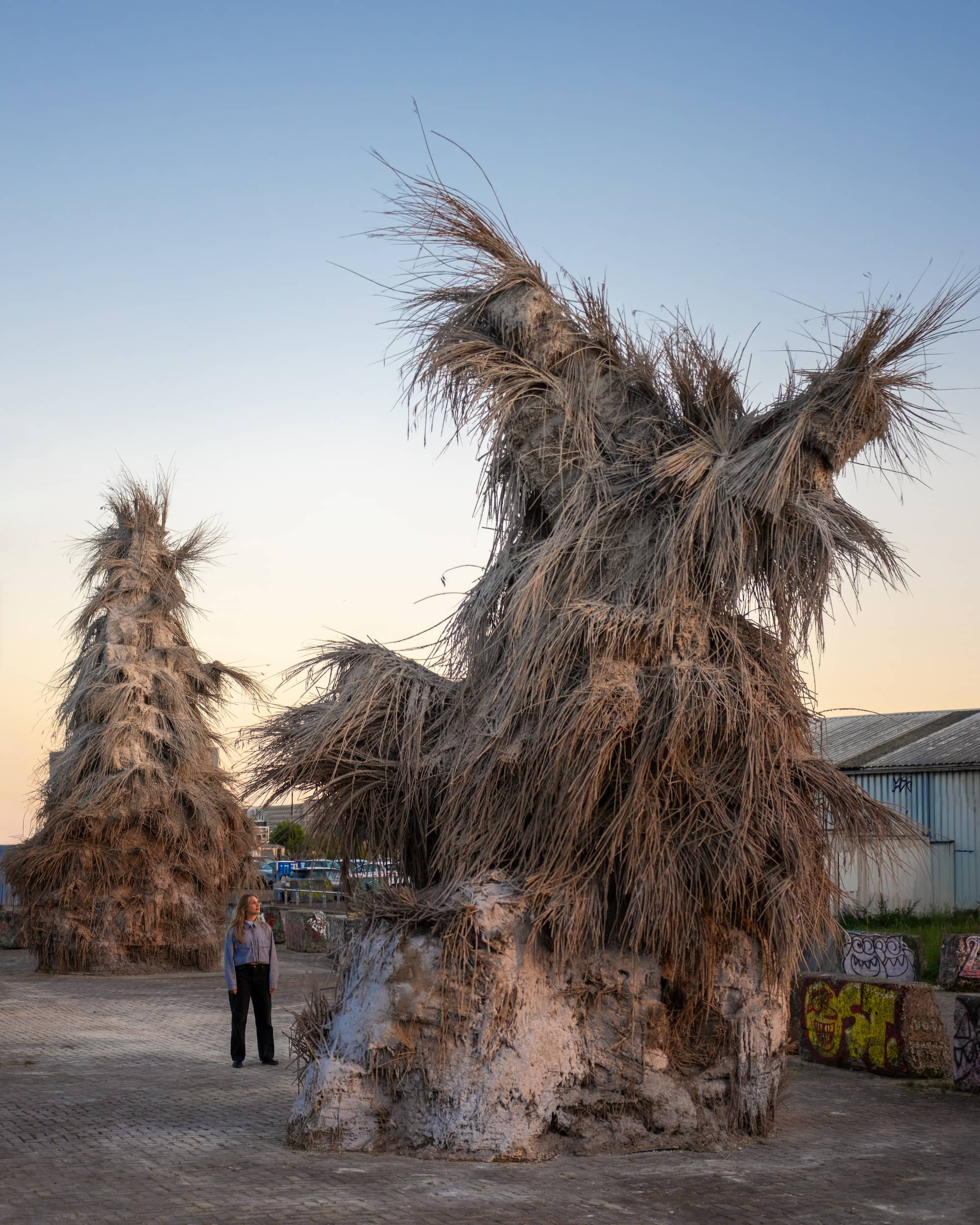
Then Morison introduces something that does not quite fit into this system. He collects leftover materials: straw, hay, oilseed rape and reeds. In the case of the reeds, it is precisely the material normally rejected by thatchers that interests him. Not the straight stems with their neat ends, but the leaves, plumes and irregular lengths. What is unusable to one person becomes essential to another.
The material resists the plan. It refuses to become exactly what was imagined in advance. Its form emerges through negotiation. Perhaps this is a useful way of thinking about change: not as something you can control, but as something you have to learn to negotiate with.
The body as a terrain
In Amsterdam, Morison’s gaze shifts from the landscape to the body. To queer and kink spaces, where bodies, roles and relationships are not assumed to be fixed. Here, it becomes clear that power does not always stand in opposition to freedom. Surrender does not have to be the opposite of control. Vulnerability can coexist with protection. Boundaries can create space for experimentation.
In BDSM, this becomes tangible. A rope holds a body in place. The body is turned, restrained, brought into a different position. And yet, all the while, there is constant attention: someone watches, feels, adjusts, tightens or loosens. Surrender cannot exist without trust.
In a dark sauna or a club, too, space emerges between freedom and attentiveness. Sometimes a glance is enough. A touch can be an invitation. Something may happen, or it may not. This tension matters, because The Argonauts are not simply intended to display physical forms. They seek to evoke the feeling of something that is just about to happen.
A hard skin, a soft interior
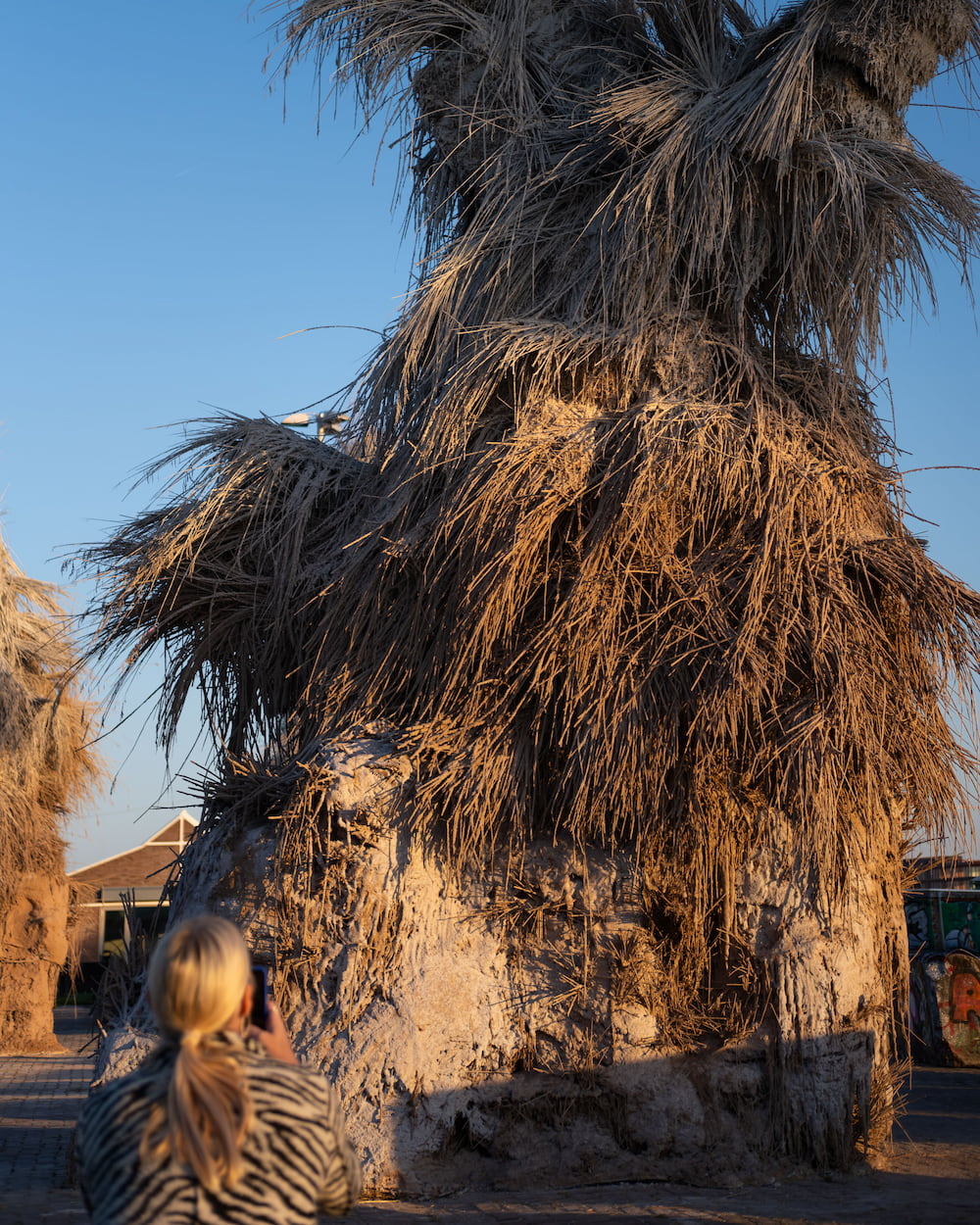
The three sculptures emerge from all these worlds at once. Straw, fermented grass and reeds are bound together, stacked and built around a structure. They are then given a hard, mineral skin. Sand, lime, minerals and plant fibres are applied until a crust forms.
Beneath this skin, the agricultural materials continue to dry, shrink, ferment and decay. The outer layer must contend with an interior that is constantly changing. Suddenly, that skin becomes something more than protection. Sometimes we build a new exterior to create more room on the inside.
No neat bodies
The three sculptures on the NDSM wharf are not neat, finished ‘bodies’. They lean towards and away from one another. One supports, another resists. They come across as dependent and defensive, tender and threatening at the same time. They seem unsure what to make of one another, and it is precisely from this uncertainty that something emerges.
Morison describes them as a temporary alliance of difficult forms. A collection of misfits held together through continuous negotiation. That may sound like a strange starting point for outdoor sculptures, but perhaps it offers a better definition. What if a sculpture does not have to say: this will last? What if it can say: this will change?
A monument that is never finished
The Argonauts do not represent queer bodies, kink practices or the Dutch landscape. These things are not illustrated. They are embedded more deeply in the work: in the materials, in the way the bodies are constructed, in the relationships they form with one another. That is also why the sculptures do not feel like an answer. Instead, they offer an invitation to let go of your own assumptions, if only for a moment.
What do we call normal? What do we call useful? When do we consider something beautiful? When do we consider something strange? And why?
On the NDSM wharf stand three strange, bodily figures that look as though they have come from another world. But perhaps the opposite is true. Perhaps they come from this world after all: from our landscapes, our bodies, our relationships, our urge to organise things, and everything that continually slips through the cracks. The Argo continues to sail as its parts change. Perhaps this is the real question at the heart of The Argonauts: not how we can remain the same, but how we can stay together as we change.
Editorial: Jessie Ottens – Date: 02 November 2026
This column was developed based on Ivan Morison’s Field Notes, with AI support in structuring and editing the text.