(Un) monumental interview: Elsemarijn Bruys
As part of the exhibition (Un) monumenting: The Future Should Always Be Better, we will talk to artist Elsemarijn Bruys. Her work Volume 2.0 will be on display at the NDSM Loods during the exhibition.
Elsemarijn Bruys (1989, NL) is a visual artist with a strong curiosity about sensory perception. In her hybrid practice, she alternates between sculptures and architectural interventions, but the spatial experience is always her starting point. She works primarily with inflatables and kinetic mirrors.
“My background in fashion has greatly influenced my material and sculptural work.”
Elsemarijn, how would you describe yourself as an artist? What does your practice look like?
Messy 🙂
Haha check. For the exhibition (Un) monumenting, you are creating a new work, called Volume 20.0. How do you see this work in the context of the (Un) monumenting theme?
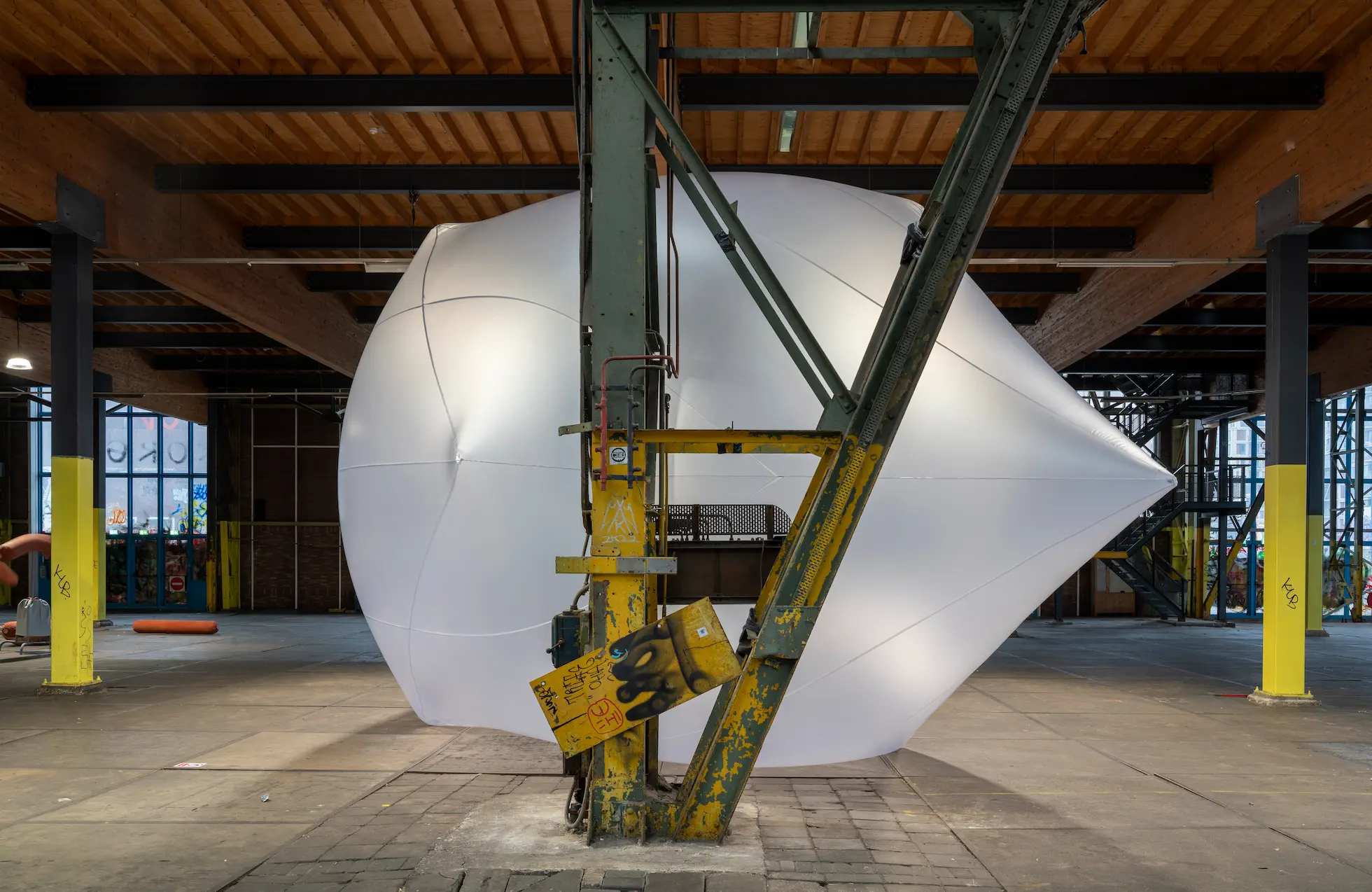
I am interested in how space and material influence each other and the effect this has on the existing architecture. With Volume 2.0 I'm creating a cube of air that seems to be bursting at the seams and fighting for space. Trapped between the pillars and the ceiling of the industrial warehouse, the semi-transparent inflatable simultaneously seems to let the environment through while blocking the view. The work is part of my research into how space can be deformed by a temporary intervention that affects human movement. In addition, refers Volume 2.0 about who and what can take up space when there is only limited space and themes such as changeability and temporality, which often form the basis of my practice. This is in line with the theme of (Un) monumenting: who can take up space in public space? Who should feel represented?
To continue “fighting for space”, the architecture and the material you choose work together. Volume 2.0 can be seen in the NDSM Loods, how does it relate to this location specifically?
The work is firmly embedded in the structure of the NDSM Loods. As a result, there is an emphasis on the gigantic scale in which you are when you enter the NDSM Loods. At the same time, the object is also of a large scale, and clasped into the pillars of the Underscate, the space takes on a different character. When you come Volume 2.0 when you walk around, you see the edges of the pillow pressing against the pillars of the NDSM Loods, almost as if it were about to splash. It gives an ominous, but also a soft feeling. The semi-transparent material also contributes to this.
“I ask a lot of questions when it comes to “taking up” public space.”
You just said that temporality and changeability are recurring themes in your work. Words that also apply to NDSM; a place full of projects that exist in temporality, a place of movement. Can you explain what interests you about these themes?
The inflatables that I make only exist by virtue of the given air: a “material” that always surrounds us without us seeing it. By filling a bag with that material, the object suddenly takes up space. In that sense, my work is temporary; it exists by the grace of air.
With the exhibition (Un) monumenting, we also want to open up the conversation about monuments in general. What are your own ideas about what monuments should be and for whom, or if they should be there at all?
I ask a lot of questions when it comes to “taking up” public space. I like to go to places where supposedly everyone goes, such as a station. What everyone uses for a purpose without interfering too much with differences in cult and culture. They are, as it were, anonymous spaces. I hope those places are not about claiming space, because I think that's a complicated topic. Whose street is it and which monument can rightfully stand there? Who does it stand for? I myself see many sculptures in public spaces as images of time and I am very happy that there are more and more different monuments for many more different people/groups/cultures.
Check out the work Volume 2.0 by Elsemarijn Bruys during the exhibition (Un) monumenting: The Future Should Always Be Better, on view until February 18, Tue to Sun from 11:00 — 18:00 at the outdoor area of the NDSM shipyard and in the NDSM Loods.