Interview: Sijben Rosa about Not Forever
On June 25, 2021, Sijben Rosa launched her work Not Forever at the NDSM shipyard as part of (Un) monumenting #2. We talked to her about her work and her vision of what monuments (in her opinion should or could) be in the context of art in public space.
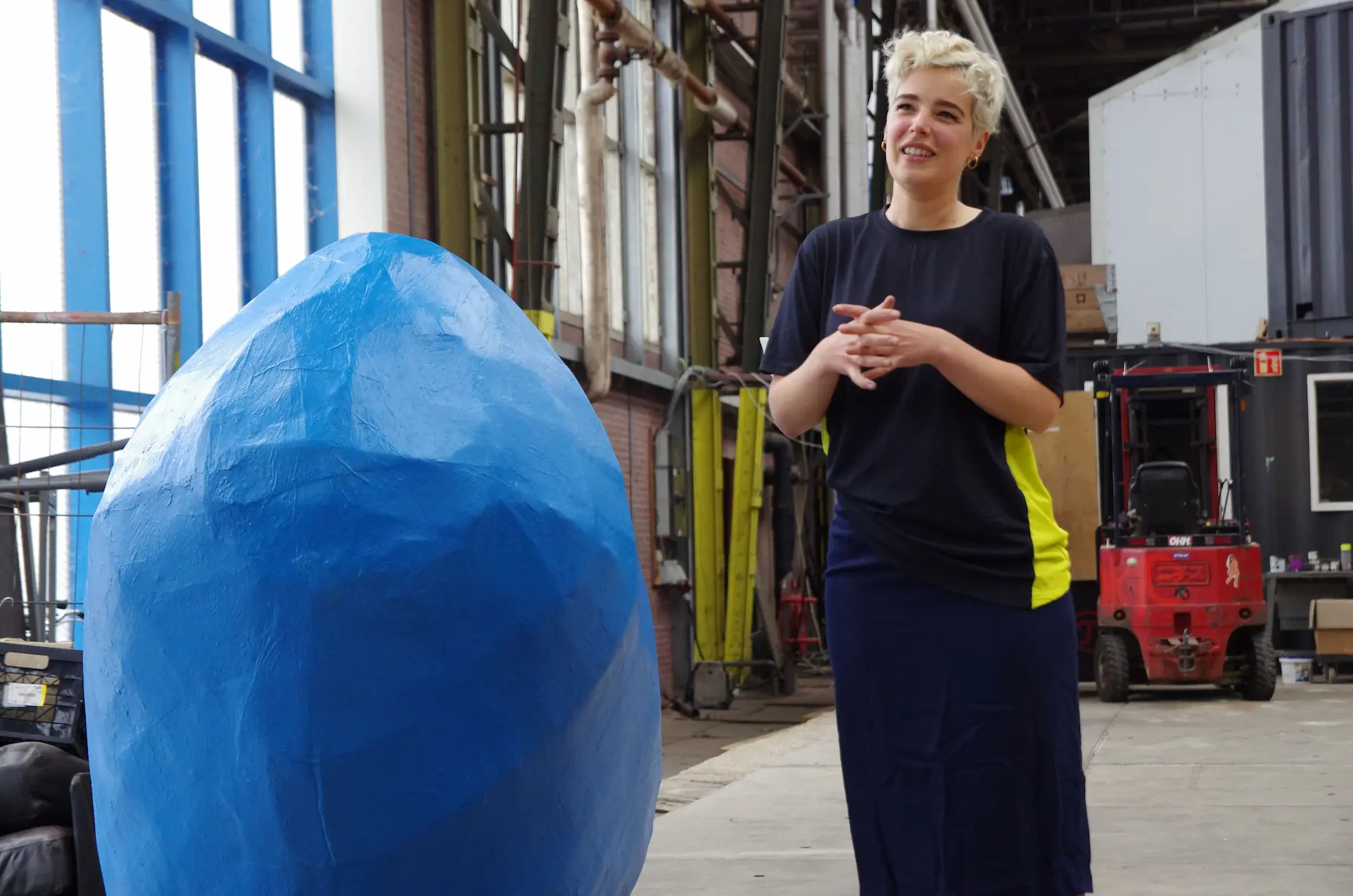
The exhibition series (Un) monumenting is about the concept of monuments today and what they should be, and who decides that. In this context, tries Rosa with Not Forever to make the versatile soul of the NDSM shipyard tangible with a large ambiguous object. The object will roam the NDSM shipyard for the next two months, each time under the care of a different shipyard user, while laden with that person's conviction about what the soul of the NDSM shipyard is.
On a sunny day, I meet Rosa in her workshop in East Amsterdam. This is an incubator in a former school building where several artists house their studio or studio. We take a seat on the building's sunny roof terrace and start talking about her work.
Rosa, when Stichting NDSM-werf asked you to make a work for (Un) monumenting, what went through your head and how did the idea of this work come about? How did NDSM end up in your work?
“I think the question from Stichting NDSM-werf came partly because I was involved in organizing a demonstration in Hoorn, where I grew up, against a monument by Jan Pieterszoon Coen that is in public space. I find it scandalous that that statue is still there and that it takes so long to remove it, if it is ever removed at all. So I've been working on the concept of monuments and who should be represented in public spaces for a while now. In addition, I have made work in public spaces in the past, for example my work Demo and Things you know, which makes me think I've ended up on the radar of the NDSM-werf Foundation. Then the Foundation asked if I could do something with the idea of a monument at the NDSM shipyard. Not so much to make a monument but to respond to the idea of monuments. At first, I found that very difficult for various reasons. First, De NDSM wharf is so big and expansive that everything you put in it has a great chance of disappearing. Secondly, the NDSM shipyard has been inhabited by artists for quite some time and so much has been done there. Each spot has been used to show something so many times that I also found it difficult to relate to it at first.”
“That's when I started thinking about what form this work should have,” Rosa continues, “I like to leave my work in the middle of the world. I sometimes find it easier to show something at a construction site than in a museum, while in a museum, something gets a lot of attention. But on a construction site, there is much more of a context that you can use and respond to, making your work even more meaningful. It is precisely this interaction that I often find interesting; I even like it to have a bit of a clash or to reveal the weirdness of art: the contradiction between a very practical, functional, direct reality and what art is.
Want to give firm shape to something that is elusive, that could represent the soul of the NDSM shipyard.
But art itself is also something very basic at the same time. Even in a museum, it's still a lot of weight that needs to be brought to that place. It's those aspects that I often really like about art because they're actually all just things. We sometimes have that tendency to forget the “thingness of art” with ourselves. We often only see ourselves as a subject, as something that has symbolic value and not as something that only takes up space, as an object or a thing. That idea fascinates me; if you were to completely disassemble a painting in a museum, you wouldn't find one piece that had the value of the work. Just like if you were to completely dissect a person, you won't find one piece that contains the soul or identity, it's in your whole being.”
So how did you end up with this object?
“What I love about monuments is that they make something you cherish together into something material and tangible. So the idea for this work is also about wanting to give permanent shape to something that is elusive, which could represent the soul of the NDSM shipyard. Which you can also easily make a topic of conversation with it. When there is a discussion about a statue in Hoorn, it is not only about that statue, of course, but also about what that statue represents, it makes the subject concrete. If you were to ask me what topic makes this work concrete? Then that's what the NDSM shipyard is at the moment, and if we continue in the same way, there won't be any more very soon.
It's about caring, and that you have to do that together, caring for a place
I am talking about climate change, among other things, but also about the fact that gentrification is knocking at the door and that the NDSM shipyard may be further commercialized and there will be less and less space for art. That's why I have the job Not Forever mentioned, also in response to a nice quote by Sasha Pevak (curator and artist ed.): 'The monument becomes visible only when it is removed'.
“What I also wanted in it,” Rosa continues, “is that it's about caring, and that you have to do that together, caring for a place. So because the object is so big and you can't move it alone, care providers always need several people to move it in and out or to a new place. Exactly those stupid practical consequences, I think that's what the artwork will be in. I think that's where the moment I'm looking for comes in. Provoking interaction, dialogue and stumbling. The intention is that each caretaker of the object gives their own interpretation, giving the object value. The work will be launched on June 25, but I think in a way it's not there yet. The object is there, but just over the next two months, all the experiences it experiences will gather in the object, which is what together becomes what I want it to be.”
You also included the aspect of transience in your choice of materials, can you tell us more about that?
“Certainly, in addition to the fact that it fits the concept of this work, I also think that, as artists, we should take responsibility for what materials we choose for our works of art. Especially for a temporary work like this, I think it's important to focus on what kind of materials I might be able to reuse from other works and what materials have the least impact on the environment. Definitely a job like Not Forever, which, of course, is also partly about climate change, I would find it hypocritical to throw a whole mountain of plastic on the table myself. That is why I chose to use materials from the recently demolished building of Sexyland. I do like the fact that there is also literally a part of the NDSM shipyard in it. Of course, that's not just because of Sexyland, but also because of what that building used to be.”
“What I'm not sure yet is what to do with the boulder after the two months that the work has been active. What reassures me is that all the material I used for it, including the screws, are all things that were already waste before it became this object. That soothes my conscience somewhat. I'm also curious what it is then, what it has become in meaning. I think the final destination also depends on what the collective idea makes of the object.”
Rosa, how do you see art in public spaces, what makes it different from art in a museum or “inside”?
“The main difference is that you didn't ask to see art in public spaces, that's something you're confronted with whether you like it or not. That's what I really like about art in the public space, it also integrates more into daily life than much other art. There is a certain piece of art that I see on my way home every day, and every day I look at it differently depending on my own state of life and state of mind at that moment. It changes shape because my mind changes and time goes by. This can also happen with monuments, just look at Jan Pieterszoon Coen, public opinion is changing (although there have always been protests against the statue), while the thing itself still looks exactly the same. When something is in a museum, it is also viewed differently. That's what I find interesting, how space and time influence the way we look at something.”
“By the way, it's not just that art is subject to the influence of public space,” Rosa continues, “but it can also be the catalyst that starts or starts a conversation. In the ideal situation, work is not only subject to external circumstances, but can also influence those conditions.”
Do you want to know more about Sijben Rosa and her work? Then check here her website. (Un) monumenting continues! In addition to the already visible work Breathing the City by artist collective Frerara on the NDSM Billboards, is also the third edition of this exhibition series in the making. Don't miss anything? Follow the NDSM-werf Foundation on our socials!
Feature: FalseDepot: TrueArticle child: read