
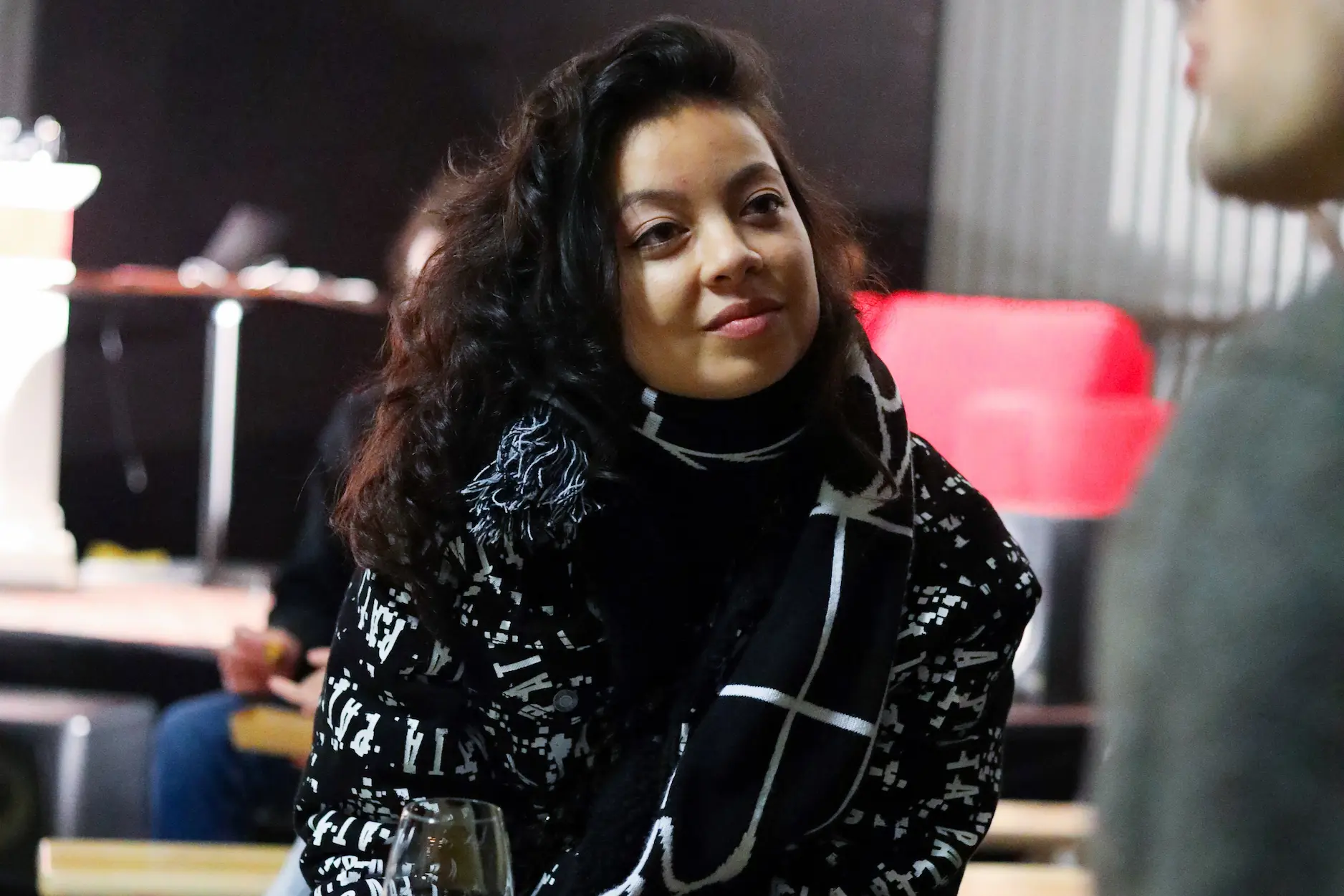
Interview: program maker and curator Isabeau Keurntjes
This winter, Stichting NDSM-werf presents (Come To) Light, an exhibition consisting of three light works by international artists. With their works, they shed light — literally and figuratively — on topics and people that are important to them. Who or what should be more or less visible in the public space? In this interview, we speak with Isabeau Keurntjes, producer, program maker, event manager, and curator for some time now. In collaboration with a diverse selection of artists, she combined the themes surrounding (Come To) Light in an exciting opening program on November 12.
Can you tell us more about your background and your experience as a curator?
My background is mainly in event management and production. I've been circling the hospitality industry for about ten years, but at some point I also started doing events — for example in the A'DAM Tower. I haven't been working as a curator very long; the first major project I did was this one at NDSM. Via Serginho (Stekkel, ed.), I ended up at the NDSM-werf Foundation. The ensuing conversation was about giving opportunities to new curators. That was absolutely right for me, because I've been doing events for a long time, but had never put together a program of this format myself.
However, as operational manager of the Members Club at the A'DAM Tower, I was already involved in community-focused and social events — a big contrast to the commercial events I've always done — and I noticed that I felt very much at home there. I want to devote part of the time I spend in this sector to events that mean something to many different Amsterdammers.
I do my job because I want to create an unforgettable experience
Corona is a big one for many people switch been. Many event managers, including me, had to quit or have a lot downtime had. That makes you wonder: when everything starts up again afterwards, what do I really want to do with this work?
Where do you get inspiration from as a curator? And what ambitions do you have when it comes to curating in the future?
I think that the value of what curators do — bringing people together through events — is underestimated. I've always said I do my job because I want to create an unforgettable experience for people. I want to touch people with a story. In that regard, a program must be right in every aspect and ensure that you are included in a story.
That's why I find it so interesting to combine my work as a curator with my experience as a producer and event manager. If the story and experience are both correct, the program will be unforgettable. I'm constantly looking online for artists and how they've been brought together at events that have already taken place.
You just turn on your Spotify, but what you don't get is the artist's entire process
What aspect of the work and the identity of curators and creators do you prefer to make visible?
In addition to the fact that people and themes were highlighted by the creators of the (Come To) Light artworks, we wanted to highlight not only individuals, but also certain professions and types of work in this program. Anna (Martinova, stage name Tulpa Dusha, ed.), for example, did a performance with live synthesizers. She thus explains the labour and expose the process of making music. Among other things, we wanted to show how many artists can't hide behind one work of art.
It's so easy for us these days. You quickly turn on your Spotify, but what you don't get is the entire process of the artist behind it. That is so understudied today. Actually, we also wanted to work with a scenographer — someone who designs plays with costumes, sets, lights, you name it. At the end of a theater performance, everyone claps and the actors are the recipients of this applause. But the scenographers are actually never in the spotlight, even though they are such a big part of it. A lot of the artists I know are very humble. They do such beautiful work, but are not exposed to enough light.
Would you describe a program as a total work of art that brings together all kinds of artists?
Absolutely. Everything you see in a program contributes to a (hopefully) unforgettable experience. We also tried to show that in this program, and it's something I try to do with every other event.
At the opening of (Come to) Light, you and Serginho Stekkel presented a number of performances about creating light and giving light. This was provided by Gershwin Bonevacia and Alistair Sung (spoken word + cello), Charissa Chotoe and Soortkill, Tulpa Dusha (synthesizers) and Charmaine Wartes (music). A very diverse list. What made you choose these names and settings? What was the main idea behind this?
As a program maker, you make a lot of considerations. I would like diversity — in the sense that all cultures are represented — to be a matter of course in every program. We are talking about Amsterdam's public space here. Of course, NDSM belongs to the North district, but for this program, I also liked to invite Soortkill from the Bijlmer, for example. Normally, he wouldn't come to NDSM so quickly, but I think it's important to bring people from different corners of the city together.
Gershwin (Bonevacia, ed.) is a vocabulary artist. He can tell the complete story so beautifully, and that makes the whole thing even stronger. But especially when a program takes place in the public space, it goes beyond a single artist and must reflect the relationships of the entire city, for example with regard to the participation of men and women and different cultures and backgrounds.
You recently participated in the very first edition of NDSM's Young Curator program, where we annually ask “young” or not so experienced program makers to put together a program or event. Here we are looking for programs that connect to the shipyard as a cultural place, but with an urban and industrial character in which public space, outdoor programming, is the starting point. What is the importance of young people in the field of curatorship for you?
If we want public space to offer space for polyphony (an important spearhead of Stichting NDSM-werf, ed.), it is important that there are curators who also attract younger people to a program. My age group connect not always good with a museum or an exhibition. By putting together a program that is indeed inviting for young people, you contribute to who they are, to their inspiration and their social, cultural and social development. That's why the story should appeal to them, and if the curators themselves are also young, this connecting function is filled more quickly.
credits
Images: Randy da Costa, Gert Jan van Rooij