
Interview: SpY on 'Barrier Tape'
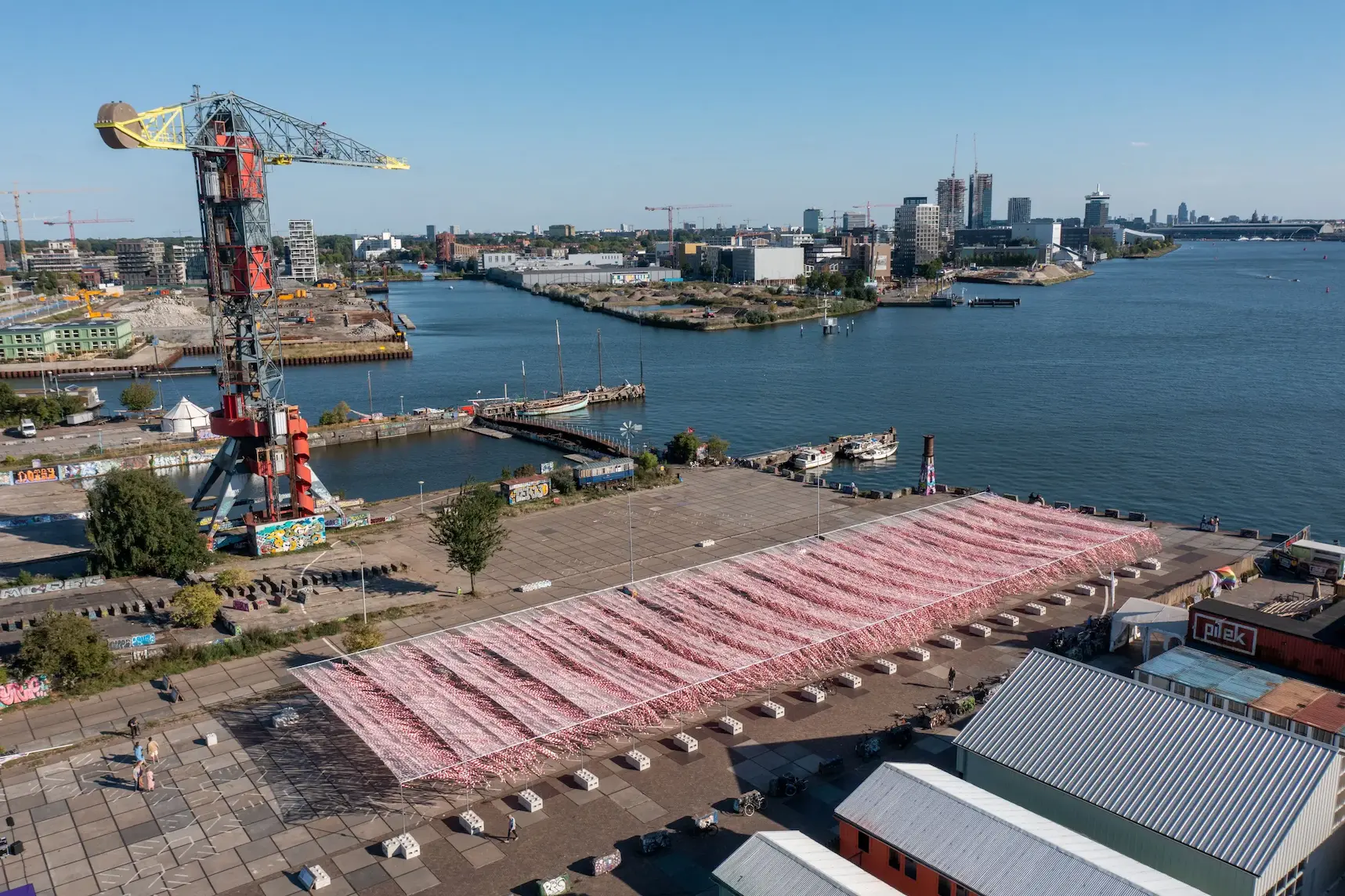
Whoever makes their way across the shipyard will be able to hear the new work 'Barrier Tape' from a distance. The countless barriers hanging on parallel strings dance together to the beat of the wind and visitors can move through and around these hypnotic “waves”. The brain behind this multi-sensory experience is Spanish artist SpY whose work has appeared internationally in many urban public spaces. SpY is known for its spectacular and large-scale public interventions and installations that are in dialogue with the environment. The artist plays with a contrast in the aesthetics of his work and the recognisable everyday urban utensils that comprise it, and also involves spectators as active participants in the artistic process. SpY designs and realises its projects from its SpY Studio platform. 'Barrier Tape' will be on display at the shipyard until September 26 and we asked the artist all our pressing questions about this work in an interview.
Who SpY is is is quite a mystery. Although what you do — your work — has (been) seen in many cities around the world. How would you describe the essence of your work?
My goal is to address the audience directly to induce reflection and dialogue, to interrogate them and to allow them to act as active rather than passive subjects. In this sense, the urban environment facilitates and promotes this process.
I look beyond the formalism or aesthetics of the works, so that my own artistic attitude and that of the audience becomes a way of building the work in its entirety.
Observing and being receptive to dialogue with the city has been the process and framework in which I have expressed and communicated my ideas for years.
Your work is very public, but you, as an artist, are not. What is the motivation behind staying under the radar?
We're living in a time of social media overexposure that creates confusing realities. We're navigating a blur of misinformation and hectic social conditioning. Distraction is preferred over concentration, the automatic over the reflexive, and confrontation over empathy. The earthly order is being replaced by the digital order that denaturalizes the world's things and emotions by automating them.
All this overwhelms me and by staying in the background, I can move quietly without exposing myself too much to the media that should create a “SpY” character where everyone expects a witty and brilliant summary of the intentions of the works.
How did you get started with what you do and how did your public interventions evolve over the years?
At the end of the 80s — attracted by the paintings I saw on the street — I started painting graffiti.
As an autodidact, I started developing my own paintings and identifying myself with my own style, I had no experience nor was educated at an art school, but I was strongly attracted to the idea of seeing my name everywhere.
After many years of working on the streets, it was as a natural evolution that I developed a keen sense of seeing the city as an artistic medium with great opportunities to create my current urban artworks.
From graffiti to the present, I have been characterised by a determination and curiosity to explore other means and formats in my work. I spend a lot of time thinking, theory, practice and managing projects. My aim is to raise important questions that generate reflection around the work, and I try to formalize and communicate these approaches through different formats.
It has been a journey where I have transformed my working method and proposed new ways of working within this framework.
There are a lot of people involved in developing your ideas, can you explain what SpY Studio's platform is and how you work?
It is a highly dynamic studio that adapts quickly to the new challenges of each project. The studio is both a laboratory space and an eclectic team of specialists, technicians and craftspeople who work together with a strong desire to learn and explore. Intertwining disciplines and collaborating with other professionals from different areas presupposes a solid work methodology that adapts well to different challenges while being flexible enough to be open to experimenting with the unexpected.
The Studio is currently researching and experimenting with kinetic art in motion and the use of new tools and media that combine the digital, mechanical, and electronic with elements of the urban imagination that we usually find on the streets of every city.
For example, we are working on a large permanent kinetic installation for the atrium of a hospital in Switzerland. It requires sophisticated engineering that integrates seamlessly into architecture and a customized programming system that will bring all the movements of the work to life. It is a project on which we will be collaborating with an engineering firm and two architecture studios, and it will take two years for the hospital to be completed and operational.
In a more ephemeral way, we recently created a 60-metre-long kinetic sculpture called ECLYPSES in the warehouses of the old weapons factory, consisting of 20 backlit mobile drives and a sound system. This work involves visitors in a unique experience through the modulation of scale, light, color and music. The different elements are combined through choreographies that form a sequence of hypnotic and compelling patterns.
And how have you developed as an artist now that your works are increasingly being picked up in many cities and by diverse cultures on different continents?
Each project is ultimately a learning process, because there is never a work like the last. It's always about new challenges where we try to understand and connect new tools, propose different research processes, and surround ourselves with the best possible team to carry them out.
As I said, through my works, I try to raise important questions that we, as a society, need to keep an eye on. This quest is formalized by conceptual contrasts between the aesthetics of my works and the difficult connotations of the objects they are built with, often elements used to condition people's behavior.
The work 'Barrier Tape' on the NDSM relates to the natural elements around it, creating a hypnotic (multi-sensory) experience for the audience. Can you tell us more about how your idea for this work came about and where this fascination with using everyday objects in your public works of art comes from?
It's about creating new works from the everyday. You start the process based on elements that are already familiar to most, but if you regroup them into a new combination, you are already creating something new and memorable.
This is a sound sculpture made with recycled deposit tape that continues the line of kinetic works with hypnotic patterns that I've explored in my latest projects.
Something fundamental in the work is the dialogue with the context and effect of the wind that plays and dances with the tapes, creating beautiful choreographies and wavy movements throughout the installation, almost as if it were a sea wave.
As you can see, it's a living work that interacts with the audience, making it part of the experience and creating a memorable moment for everyone.
Your works are in dialogue with their urban environment. 'Barrier Tape' explores the urban context of the NDSM and recalls the ever-changing nature of this place and the city of Amsterdam. How do you view or approach these changes as someone who is not from here and how do you translate this into a work?
I believe that, as an artist, you should not strive for the complacency and acceptance of the widest possible audience with your propositions. You have to be faithful and consistent in what you want to express, and work within an artistic rigor, even if not everyone likes it. But you also need to understand the context in which you are exhibiting your works and enter into dialogue with it, because we have an important responsibility when we share our creations with neighbours and residents who give up their space, otherwise we are not much different from the mass advertising noise.
Finally, you'll explore the urban environment as a “playing field full of untapped opportunities”. What kind of “playing field” do you think the NDSM is?
Without a doubt, the urban environment is a framework that offers great opportunities to work and propose artistic projects. From micro, as a small intervention on an urban element, to macro with a large installation in the urban core of a city.
Cities can generally be quite rigid, but the street acts like a living entity with blood flowing through it. It is not an aseptic space like the gallery, museum, or stock exchange. It is constantly evolving and that is part of the creation process of the works.
In the case of 'Barrier Tape' at NDSM, the artistic proposal in this public space is aimed at making passers-by complicit in their own city, and thus leaving behind the monotony that usually takes up their lives in big cities.
Rarely do we find artistic performances that break into the everyday life of cities to generate reflection and dialogue between creators, cities and citizens.
credits
Images: Benjamin Kotek, Gert Jan van Rooij, Ruben B Pescos, Jann Senn