Interview: Amauta Garcia & David Camargo
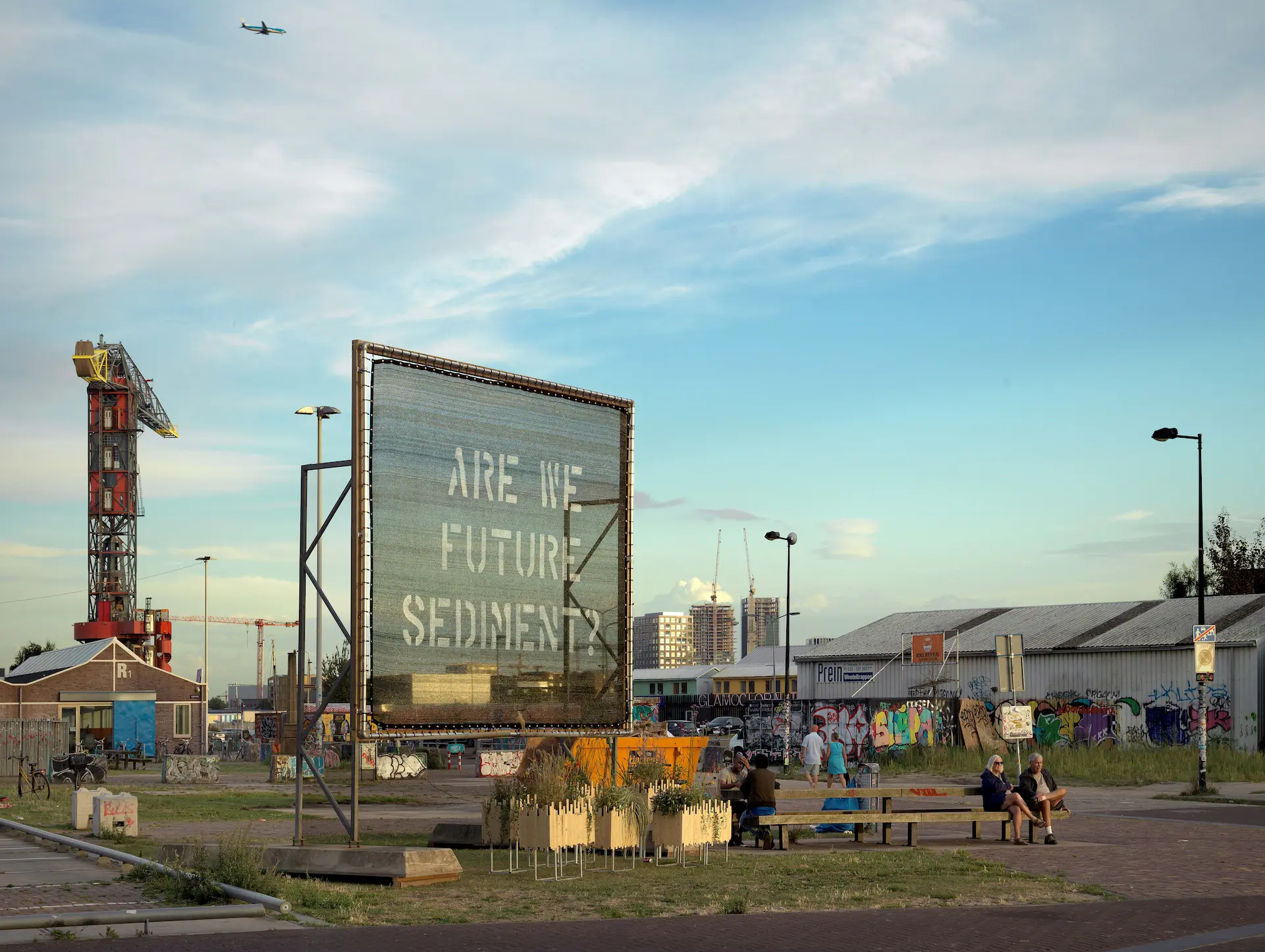
“Are We Future Sediment?” (Are we future sediment?) is the question asked on the five-metre-high billboard that was placed on the NDSM at the beginning of this month. This temporary installation is part of a new project by Mexican artist duo Amauta García and David Camargo, who are currently artists-in-residence at the Jan van Eyck Academy in Maastricht. The artists submitted the winning entry for the Open Call that the NDSM-werf Foundation launched among the Academy's participants. With this work, García and Camargo visualize the situation in which Amsterdam could be in fifty years; namely five meters under the sea.
García and Camargo met fifteen years ago and have been collaborating on various projects since 2011. García's work includes sculptures, videos and interventions in public spaces and addresses socio-political themes, including unequal housing opportunities in cities. Camargo is a visual artist whose work focuses on exploring stories about the notion of simulacrum (an image or representation of someone or something) in the context of an image-driven society. Together, they founded an artist collective in Mexico City called 'Colective Trafico Libre de Conocimientos', TLC (Free Knowledge Traffic Collective). The collective has five other members and experiments with public space, education and art and focuses on critical thinking, collective learning and knowledge sharing.
The rather compact city of Maastricht is a completely different world for the artist duo as they are used to traveling long distances in Mexico City. Their stay in the Netherlands has given them more time to focus on their projects and the residency at the Jan van Eyck Academy provided them with the opportunity to share their work and research with different people and gather their input. Thanks to the Open Call, the artists were also able to discover the capital. They had never heard of the NDSM in Amsterdam before, but during their research, they learned a lot about the rich history of the former shipyard and the city's possible wet fate. The latter inspired them to come up with the idea for the installation 'Are We Future Sediment? ' on the NDSM.
Water is a recurring theme in García and Camargo's work, which they approach in a very poetic way. They found that there is such a contrast in the relationship that the Netherlands has with water compared to Mexico. “In Mexico, we have a lot of problems with water, but unlike in the Netherlands. In Mexico, there is a shortage of them. There is a lot of rain, but nothing is being done with it. The water that falls mixes with the city's soil, making it dirty right away,” explains García. “The drought in Mexico is very complex. In that regard, we need to think about how we can capture the rain,” she continues. For the Open Call, she proposed an idea for a fog catcher that they had wanted to realize in Mexico but were not yet able to achieve. “It's a really good opportunity to learn how to do it, and maybe we can do it there too when we return to Mexico,” says García. “It's like a sketch for other projects,” Camargo adds.
The installation created by the artist duo consists of a five-metre-high banner whose structure is usually used for public advertising along roads in the Netherlands. Within this structure, there is a mesh fog catcher that captures water droplets in the air. It is essentially a water collector that condenses the rain and, via a piping system, the water is led to the mobile garden in front of it. The total height of the structure is five meters; the estimated level that the water will reach in five decades if no action is taken. The most striking is the message that is embroidered on it: “Are we future sediment?”
Instead of fighting against the water, maybe we can accept that it was here before we did. How can we live with it and not against it?
The artists reflect on the idea that the current soil of Amsterdam can become the sediment of tomorrow. “In that sense, we are the future sediment. And we have to think about what kind of sediment we want to be,” says García. Their approach to the threatening waters is quite unique. “Instead of fighting against the water, maybe we can accept that it was here before us. How can we live with it and not against it?” , adds García. “The problem is that we now only see water as an object, in a very utilitarian way. Maybe it would be good if we could develop a kind of empathy for it,” she continues. That is why the work not only captures the water, but also welcomes it.
Before working on this project, García and Camargo started researching two underwater volcanoes located at the bottom of the sea in the north of the Netherlands. These volcanoes formed the bottom of the Jurassic era and are now part of the marine sediment. “You have to remember that volcanoes and water are entities of nature,” says Camargo. “Something we're thinking about is whether water and volcanoes have their own agency and how we can understand that. How can we develop a different relationship with them? Instead of seeing them as things or resources, we can see them as subjects with their own rights and way of life,” adds García. With their installation at the NDSM, they want to “continue this exploration of water as a living being with a geological memory.”
Public space isn't just the physical thing, the path, the park, the street or the square. It is the relationships that develop that space. It's about people sharing experiences.
The artists regard the NDSM as a very valuable public space where many different things and projects exist at the same time. They emphasise the importance of the human element in public space. “I think working in public spaces can cause that effect of weirdness. It's like a shock to people because they're not used to seeing something like that and it allows people to share something with each other. I think that public art can increase the 'public' in public spaces,” says García. “Public space isn't just the physical thing, the path, the park, the street or the square. It is the relationships that develop that space. It's about people sharing experiences,” she adds. After the public intervention, the duo wants to donate the plants that make up the mobile garden to people who live and work in the neighborhood.
García and Camargo deliberately chose to incorporate a familiar object — the banner — into their work to take it out of its usual context. “I love works that use ordinary street objects, such as billboards like this. I see them a lot in the Netherlands for marketing and advertising purposes. They can sell anything on it: products, houses or dreams. But we can also use them for other ideas, and people will recognize them anyway,” says Camargo. “It shows the possibility of objects,” adds the artist. In this context, the banner is used to convey a message that the artists hope people will think about. “I think it's kind of a joke in a way. The billboard is like a tombstone,” notes Camargo. “It's a question about time. The time is huge, it is massive. Human life takes 100 years, but Earth's time is another concept,” he continues. “So it's an invitation to think about the future, but also about the present. What kind of future are we building right now?” , adds García.
click here to follow Amauta García and here to follow David Camargo on Instagram.
Feature: FalseDepot: TrueArticle child: read