Talking to Luca Boscardin about his wildlife
Luca Boscardin, one of the winners of the 2021 NDSM Open Call, is launching his work Animal Factory at the NDSM shipyard. The installation consists of a number of full-size minimalist metal animals that will roam the shipyard in the coming months. We spoke to Luca about his work and artistry at NDSM.
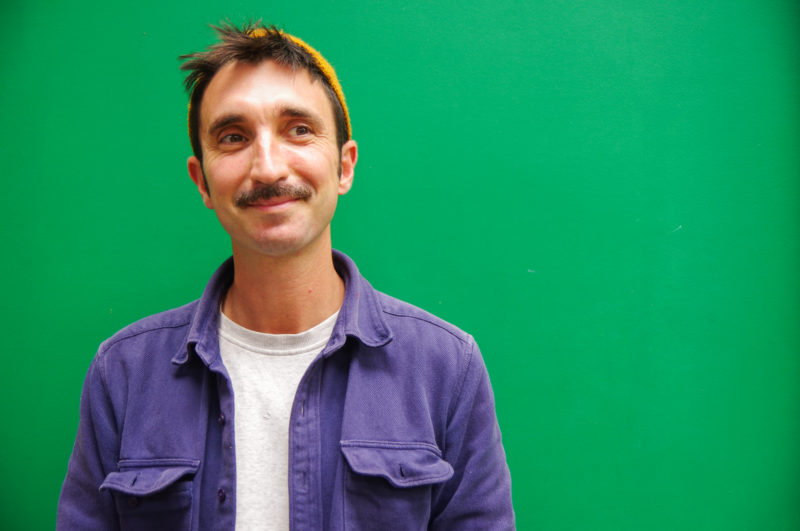
I met Luca in his studio in the Art City in the NDSM Loods. After making my way through the labyrinth of studios and workspaces, I came to a spacious room decorated with various Luca toys. This creates a very colorful and playful environment that lifts the mood the moment you step in. After catching up, we had met before for some photos, sat down at a big table in the studio and started the interview.
So, Luca, can you tell me a little bit more about yourself and your art?
“Of course! I'm originally from a very small town in northern Italy. That's where I decided to study architecture in Venice. After graduating, however, I realized that, as much as I love architecture, I wasn't able to incorporate anything from Luca into the designs of buildings, parks, or other large-scale things. I couldn't express myself in designing on such a large scale. That's why I decided to do a master's degree in graphic design, in an attempt to reduce the scale in which I design. The interesting thing is that for everything related to design, the process is the same, but the outcome will be different. I was able to use the same skills I had learned in architecture and apply them to graphic design.”
I realized that a lot of animals came out of my pencil
“Although I really enjoyed graphic design and playing with colors and graphics, I felt that my heart wasn't really beating for work. That was when I decided to move to Amsterdam. When I arrived, I came across a beautiful studio where designs were made for children's toys. As soon as I saw it, I was mesmerized. There are people who actually do this work, it's not just a hobby but a real profession! So I delved into it and got completely caught up in it. I love this work, it's an exceptionally beautiful thing. So my art started with architecture, but let's just say I found a way to best express myself in toy design. I learned the hard skills of design by studying architecture and graphic design and discovered how to put love into my work by making toys.”
“The toys that I design are not objects that you just look at, they are all objects that you can play with. For me, playing means learning, and learning is discovering something you don't know yet. That's also what I do with my toys, I don't give the user, the kids, a ready-made toy, they need the action of playing to finish the toy. That's why architecture was really important because it gave me a lot of rules and a grid that I can use when making these kinds of toys. A strong design makes toys free and easy to play with. With all my toys, I try it out at workshops with children. It is wonderful to see how children play with your toys and that they actually work. Children are also incredibly honest, so they will ask you very direct questions if something is unclear to them.”
“The idea started with the concept of simplicity, like almost everything I make. I bought oil-based pasta crayons, which are made from a type of paste that can be used for a very rough way of drawing, with thick lines that you can't erase. With these colored pencils, I did an exercise to draw things that consist of just one line. I tried to work and play in the same way that kids would work and play. In doing so, you will discover the most important characteristics of animals, the long neck makes it a giraffe and a few stripes make it a zebra. In that context, I started designing on a piece of paper and realized that a lot of animals came out of my pencil.”
“Somehow, I was also fascinated to go big and wild with this project. So for this design, I just tried to imagine it on a larger scale, something to play on instead of something to play with alone. Then I had the thought: what if they could be in the proportions of the real animals they represent? Imagine cycling through the city and out of nowhere you find a crocodile in the park, or a giraffe around the corner from a building. At the time I was playing with this idea, we were back in lockdown and you heard on the news how wild animals were spotted in the city streets because it was so quiet there at night. This gave an extra layer to this idea of wildlife in the city.”
Animal Factory goes beyond just being toys
Can you also tell us a bit more about why you chose to submit Animal Factory for the NDSM Open Call?
”Animal Factory goes beyond just being a toy. In terms of design and use of materials, it is certainly a challenge for me. I feel like I'm also playing while I'm designing and making it. In addition, I think that NDSM is a perfect place for these kinds of projects. Fortunately, there is still a bit of nice chaos and clutter here. There is room to improvise and be surprised. That's why I think meeting a giraffe at the NDSM shipyard is crazy, but also quite normal somewhere. It's a beautiful place full of energy and creativity where lots of great ideas are born. Imagining that the animals will actually roam the streets of NDSM and that children and other people will actually play and interact with them is a wonderful idea. Because of the simple design, I think the family of four animals that we have now can easily grow in the future. They may also be able to migrate to other parts of the city, or to other cities in general. The animals here in this studio just started on a piece of paper. Now we are building them in a steel workshop and they will be at NDSM in the coming months. But I'm sure they're going to other places too. One way or another, they live and go their separate ways.”
The animals of Animal Factory will be on display at the NDSM wharf from August 19 and everyone is welcome to play, chill, exercise or just hang out! I highly recommend visiting Luca's studio or website because viewing his designs is a real mood booster! Check out his website below
“The simplicity of designing the lines on paper is linked to the design process and the way the animals were built. They are made of steel tubes, handled by a steelsmith at NDSM, just as simple as the lines are drawn on paper, nothing more and nothing less. I always think that when you get to a point in your design where you can't take anything else away without the product losing its functionality, you're close to a good product. Bee Animal Factory every line counts, because each line defines a part of the animal and each line also counts for the animal's stability. There is a certain beauty in that simplicity. Due to their simple design, the animals offer the freedom to have multiple ways of use or interpretation. For example, I can imagine kids playing with them, but I also see a group of teenagers just hanging around them or someone else using them while exercising. We all want and need to use our creativity, play and occasionally think of something fantastic and crazy. That's what we need in our lives, I think.”
Can you tell us more about the collaboration with Iwan Snel, the steelsmith who made the animals?
“Yes, that's actually quite an interesting story. One of the great things about the NDSM shipyard is that you can find many different types of people. That's part of the privilege of working here. One day, I just knocked on Iwan's door and asked if he wanted to be part of this project. He loved the idea of the animals and decided to jump in. It's really nice how sometimes a great idea or project connects very different people.”
“I love the contrast between us. I'm a little Italian, really chaotic and noisy, while he's a quieter, big Dutch Nordic guy who works in this workshop full of steel, iron and tools. But even though we seem very different, we were a great match from the start. What is really nice to see is that, as a designer, I am free in my ignorance to draw what I want without knowing what is actually, materially possible. In turn, he knows the machines and tools, their capacity and limits, and the technology needed to build the structures. This provides a nice balance, because I can go wild in my design, unlimited by practicality, and he can then show me the limits of what is possible, creating a kind of golden mean. That's why I think a project is strong when it's nurtured by different people with different areas of expertise. Because there are so many different people with so many different talents here at NDSM, it will be a perfect playground for great projects.”
Feature: FalseDepot: TrueArticle child: read